Best Electronic Learning Toys for Toddlers: Parent Buying Guide
Electronic learning toys are everywhere.
They talk, sing, flash, count, ask questions, play music, and promise to teach toddlers letters, numbers, colors, words, and even foreign languages.
Some of these toys can be useful. Others are little more than noisy plastic with a speaker.
For parents, the challenge is not finding an electronic toy. It is finding one that actually supports learning without overstimulating the child, breaking after a few weeks, or turning playtime into passive screen time.
This guide explains which electronic learning toys are best for toddlers, what features matter, what parents should avoid, and how to decide whether an expensive “smart” toy is really worth the money.
First: What Should a Toddler Learn From a Toy?
Toddlers learn best through movement, repetition, imitation, conversation, and hands-on exploration.
At this age, the goal is not formal education. A two-year-old does not need to complete quizzes or memorize dozens of facts.
A useful learning toy should support simple skills such as:
Recognizing sounds
Learning new words
Matching shapes
Identifying colors
Counting small groups
Following basic instructions
Pressing, turning, pulling, and moving
Copying songs and actions
Developing hand-eye coordination
Understanding cause and effect
Electronic features should support these skills, not replace active play.
The Best Electronic Toys Keep Children Involved
A good electronic toy requires the child to do something.
The toddler may need to press the correct button, place a shape in a slot, turn a page, match a picture, dance to a song, or answer a simple question.
A weak electronic toy does everything by itself.
It flashes, sings, talks, and performs while the child watches.
That may hold attention for a few minutes, but attention is not the same as learning.
The best products combine sound and light with physical interaction.
Talking Books and Electronic Reading Pens
Talking books are among the most useful electronic learning toys for toddlers.
A child touches a picture, word, letter, or character and hears a corresponding sound.
Depending on the product, the book may teach:
Animal sounds
Everyday vocabulary
Numbers
Letters
Colors
Songs
Short stories
Basic questions
Electronic reading pens can also work with several compatible books.
This may be a better long-term purchase than a single talking book, but parents should check the price of additional book sets.
What to look for
Choose a product with clear speech, durable pages, simple controls, and adjustable volume.
Avoid books that speak too quickly or include so many sounds that the child cannot focus on the words.
The toy should still feel like a book, not a collection of random buttons.
Interactive Alphabet Toys
Alphabet toys can help toddlers become familiar with letters and sounds.
These products may include:
Letter buttons
Magnetic letters
Alphabet boards
Talking wall charts
Phonics tablets
Letter-matching games
For toddlers, letter exposure should remain playful.
The toy may say the letter name, produce its sound, or connect it with a familiar word.
For example:
B for ball
C for cat
D for dog
Parents should not expect a toy to teach reading independently.
The greatest benefit comes when an adult repeats the sound, names objects, and encourages the child to respond.
Electronic Number and Counting Toys
Counting toys can help children connect number words with physical quantities.
A toddler may press the number three and hear the toy count three objects. Another toy may ask the child to place three pieces into a container.
The strongest number toys combine electronic feedback with real objects.
Look for toys that teach:
Counting from one to ten
Number recognition
More and less
Simple matching
Basic shapes
Simple patterns
Avoid products that move too quickly into written addition or subtraction before the child understands basic quantities.
Musical Learning Toys
Music can support language, rhythm, memory, movement, and coordination.
Electronic musical toys may include:
Small keyboards
Musical mats
Singing microphones
Toy drums
Sound panels
Dancing toys
Action-song players
The best musical toy encourages the child to participate.
A toddler may clap, dance, copy a rhythm, sing a repeated word, or press keys to create different sounds.
Parents should check the volume before purchasing.
Some toys are surprisingly loud even at the lowest setting.
A useful product should have a clear volume control or a physical switch.
Electronic Shape Sorters
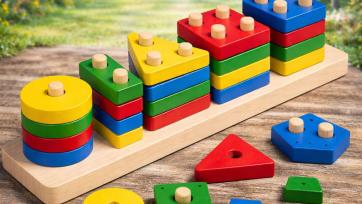
Traditional shape sorters are already valuable learning toys. Electronic versions add sounds, music, or spoken feedback.
For example, the toy may name the shape when the child places it into the correct opening.
This can reinforce:
Shape recognition
Color identification
Fine motor skills
Problem-solving
Cause and effect
The electronic feature should remain secondary.
If the toy becomes useless when the batteries run out, it may not provide good value.
A strong electronic shape sorter should still work as a normal hands-on toy without power.
Activity Tables
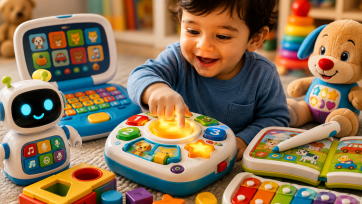
Electronic activity tables are popular for babies and young toddlers.
They often include buttons, gears, lights, songs, sliders, spinning pieces, and detachable parts.
These tables can encourage standing, reaching, pressing, twisting, and moving around the toy.
However, more features do not always mean better learning.
A crowded activity table with constant noise may overwhelm some children.
Look for a table with clearly separated activities and several manual features that work without sound.
It should also be stable enough that the child cannot easily pull it over.
Toy Laptops and Learning Tablets
Toy laptops and child learning tablets usually include letters, numbers, music, simple games, and quizzes.
They may appeal to toddlers because they resemble adult devices.
However, these toys vary greatly in quality.
Some have tiny screens, unclear voices, confusing menus, and poor buttons. Others offer simple, age-appropriate activities.
Before buying, check:
Screen size
Sound quality
Button size
Difficulty level
Number of useful activities
Whether the toy requires internet access
Whether content can be updated
Whether the screen is too bright
Whether advertisements are included
For very young toddlers, physical buttons and simple tasks are usually more appropriate than complicated menus.
Interactive Plush Toys
Talking animals and dolls can sing songs, tell stories, ask questions, or respond when touched.
These toys can encourage pretend play and emotional interaction.
Some plush toys teach body parts, bedtime routines, words, or songs.
Parents should carefully consider connected plush toys that contain microphones or require an online account.
A simple talking toy with pre-recorded phrases may be more suitable for a toddler than a cloud-connected toy that stores voice data.
Washability is another major issue.
Check whether the electronic unit can be removed before cleaning.
Learning Remote Controls and Toy Phones
Toddlers are often fascinated by remote controls and smartphones.
Toy versions can redirect that interest toward a safer object.
These toys usually include large buttons, lights, sounds, numbers, and pretend conversations.
They can support:
Number recognition
Pretend play
Fine motor skills
Vocabulary
Cause and effect
However, parents should avoid toys that encourage constant button pressing without meaningful interaction.
A better toy phone may include simple role-play prompts, songs, and recognizable everyday sounds.
Bilingual Electronic Toys
Many electronic learning toys advertise bilingual learning.
These products may name colors, animals, numbers, or objects in two languages.
They can provide useful exposure, especially when the family already uses both languages.
But a toy alone will not make a toddler bilingual.
Language learning requires regular conversation, listening, repetition, and meaningful interaction with people.
Before buying, listen to the pronunciation if possible.
Poor-quality audio or unnatural translation reduces the educational value.
Electronic Toys by Age
For 12 to 18 Months
Choose simple toys with large buttons, music, lights, and basic cause-and-effect activities.
Good options include:
Musical activity centers
Talking animal toys
Large-button sound books
Stable activity tables
Simple shape sorters
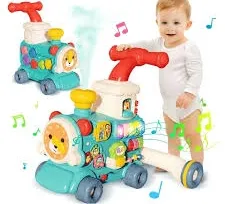
Push-and-play toys
At this age, avoid complicated instructions and small detachable pieces.
For 18 to 24 Months
Toddlers may begin matching pictures, copying words, identifying familiar objects, and following simple prompts.
Suitable toys include:
Talking books
Number buttons
Interactive puzzles
Musical instruments
Basic alphabet toys
Pretend phones
Simple learning tablets
The child should not need to navigate several menus to begin playing.
For Ages 2 to 3
Children may be ready for simple questions, matching games, songs with actions, and beginner language activities.
Useful options include:
Electronic reading pens
Bilingual word toys
Interactive maps
Toy laptops
Talking puzzles
Musical mats
Simple memory games
Choose toys that allow the child to succeed without constant adult correction.
Features Worth Paying For
Some features genuinely improve usability.
Adjustable Volume
This is essential.
Parents should be able to reduce the sound without covering the speaker with tape.
Clear Voice Quality
Words should sound natural and easy to understand.
Poor audio can confuse children who are still learning pronunciation.
Durable Buttons
Toddlers press hard, drop toys, and repeat the same action many times.
Buttons should respond reliably.
Automatic Shutoff
This saves battery power when the toy is left unused.
Multiple Difficulty Levels
A toy that grows with the child may provide better value.
Offline Functionality
For toddlers, internet access is usually unnecessary.
Offline toys are often simpler, safer, and easier to use.
Replaceable or Rechargeable Batteries
Check the long-term cost.
A toy that consumes disposable batteries quickly may become expensive.
Features That Often Add Cost Without Much Value
Parents should be cautious about paying extra for:
Wi-Fi connectivity
Voice assistants
Camera features
Facial recognition
Complex mobile applications
Subscription-only lessons
Large numbers of repetitive songs
Artificial intelligence claims
Progress tracking for very young children
A toddler does not need detailed performance analytics.
Parents can usually understand the child’s progress by playing alongside them.
The Noise Problem
Electronic toys are often designed to attract attention in busy stores.
That means they may use loud music, flashing lights, repeated phrases, and rapid sound effects.
At home, the same features can become irritating or overwhelming.
Some toddlers may become frustrated when too many sounds play at once.
Before buying, ask:
Can the volume be lowered?
Can music be turned off?
Can the lights be disabled?
Does the toy repeat sounds constantly?
Does it continue talking without interaction?
A quieter toy is not necessarily less educational.
In many cases, it allows the child to concentrate better.
Safety Checks Before Buying
Parents should inspect electronic learning toys carefully.
Check for:
Secure battery compartments
Screws over button batteries
No loose wires
No sharp plastic edges
No damaged charging ports
No easily detached small pieces
No loose magnets
Strong speaker covers
Safe charging instructions
Age-appropriate materials
Button batteries are especially dangerous if swallowed.
A battery compartment should require a tool to open.
Do not continue using a toy if the battery area becomes hot, damaged, swollen, or wet.
Battery-Operated vs Rechargeable Toys
Battery-operated toys are often cheaper initially, but replacement batteries increase the long-term cost.
Rechargeable toys may be more convenient, but charging safety matters.
Disposable batteries
Advantages:
Easy to replace
No waiting for charging
Toy can be stored for long periods
Disadvantages:
Ongoing cost
Battery waste
Risk of leakage
Frequent replacement
Rechargeable batteries
Advantages:
Lower long-term cost
Convenient for regular use
Less battery waste
Disadvantages:
Charging time
Battery may weaken over time
Replacement may be difficult
Damaged lithium batteries can be dangerous
Parents should supervise charging and use the recommended cable.
Should Toddlers Use App-Connected Toys?
Most toddlers do not need app-connected toys.
An application may offer extra songs, updates, or parent controls, but it may also introduce:
Account registration
Data collection
Advertising
Device compatibility problems
Subscription fees
Internet dependence
More screen time
If an app is required, parents should install and test it before giving the toy to the child.
Do not provide unnecessary personal information.
Check what permissions the app requests and whether the toy remains useful without the connection.
Are Electronic Learning Toys Better Than Traditional Toys?
Not necessarily.
Electronic toys can provide immediate feedback, sounds, pronunciation, songs, and guided activities.
Traditional toys often provide more imagination, flexibility, conversation, and physical exploration.
A balanced toy collection may include both.
For example:
An electronic alphabet book for sound recognition
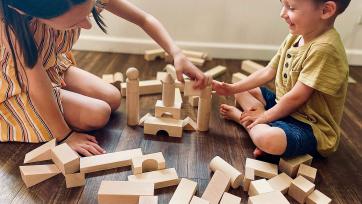
Blocks for building
Dolls for pretend play
Puzzles for problem-solving
Art supplies for creativity
Balls for physical movement
Books for shared reading
The problem begins when electronic toys replace every other form of play.
Common Buying Mistakes
Buying Too Advanced
Parents may choose a toy intended for older children because it appears to offer more learning.
In reality, a complicated toy may frustrate a toddler and remain unused.
Choosing Based on the Number of Features
A toy with 100 songs is not automatically better than one with 10 well-designed activities.
Ignoring the Sound
Always test the volume when possible.
Forgetting Battery Costs
Check the battery type and expected usage.
Assuming “Educational” Means Effective
The label is a marketing term.
Look at what the child actually does while using the toy.
Buying Too Many Talking Toys
When every toy talks, sings, flashes, and demands attention, children may struggle to engage deeply with any of them.
A Simple Test Before Purchasing
Ask these five questions:
What skill does this toy support?
What will my child physically do with it?
Can it be used without batteries?
Is the sound adjustable?
Will it still be useful in six months?
If the answers are unclear, the toy may not be worth the price.
Final Recommendation
The best electronic learning toys for toddlers are simple, durable, age-appropriate, and interactive.
Talking books, musical instruments, number toys, shape sorters, activity tables, and basic learning tablets can all be useful when they encourage the child to respond and participate.
Parents should avoid toys that rely on nonstop noise, flashing lights, complicated apps, hidden subscriptions, or unnecessary data collection.
Electronic features should make play more meaningful—not more distracting.
For toddlers, the smartest toy is rarely the one with the most technology.
It is the one that gives the child a reason to touch, listen, think, speak, move, and play again.