The Five-Minute Rule: Why Children Abandon Some Toys Almost Immediately
Introduction
Watch a child receive a brand-new toy.
For the first few minutes, the excitement is impossible to miss.
The packaging is torn open.
Buttons are pressed.
Pieces are explored.
Questions are asked.
Everything suggests this new toy is about to become an instant favourite.
Then something unexpected happens.
Five minutes later, the toy is sitting quietly on the carpet while the child has wandered off to build a fort with sofa cushions or create a pretend café using kitchen utensils.
What changed?
Did the toy suddenly become boring?
Did the child lose interest?
Or was something else happening all along?
Many parents assume short attention spans are the reason children quickly abandon certain toys. While attention certainly plays a role, the real explanation is often much more interesting.
The first five minutes of play reveal something important about the design of a toy—and about the way children naturally learn.
The First Five Minutes Are About Discovery
Every new toy begins with exploration.
Children examine its shape.
They discover moving parts.
They test buttons.
They investigate sounds, textures and colours.
During this stage, curiosity is at its highest.
Everything is unfamiliar.
Everything feels exciting.
Toy designers work incredibly hard to make this first impression memorable.
Bright colours, interesting textures and surprising features all compete for a child's attention.
But first impressions are only the beginning.
What Happens After Curiosity Fades?
Eventually, every child reaches the same question.
"Now what?"
This is where many toys quietly reveal their biggest weakness.
If every feature has already been discovered, there's little left for the child to contribute.
The toy continues performing.
The child simply watches.
Open-ended toys follow a completely different path.
Once the initial exploration ends, the real play begins.
Instead of asking the toy for entertainment, children begin supplying their own ideas.
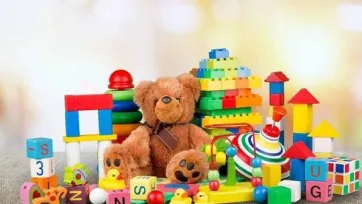
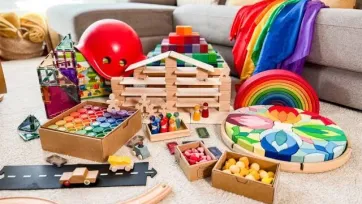
A handful of wooden blocks suddenly becomes an airport.
Magnetic tiles become a castle.
Toy animals organise a safari.
The excitement shifts from discovering the toy to creating something new with it.
The Difference Between Surprise and Possibility
Some toys rely almost entirely on surprise.
Lights.
Music.
Movement.
Secret compartments.
Hidden buttons.
Surprises are wonderful—but they only happen once.
Possibility is different.
Possibility never runs out.
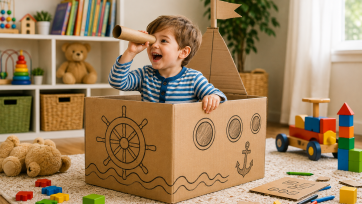
A cardboard box has almost no surprises.
Yet children regularly spend hours with one because every new idea creates another possibility.
That's why many of the simplest toys remain favourites long after complex gadgets have been forgotten.
Children Don't Actually Get Bored That Quickly
Parents often say,
"My child gets bored after five minutes."
More accurately, children become bored when a toy stops asking anything of them.
If every action produces the same result, curiosity naturally fades.
When toys encourage children to imagine, experiment and solve problems, attention often lasts much longer than adults expect.
The child hasn't changed.
The opportunity to create has.
A Simple Test Every Parent Can Try
The next time your child receives a new toy, don't judge it by the first reaction.
Instead, quietly observe what happens after the excitement settles.
Ask yourself:
-
Are they inventing new ways to play?
-
Are they combining the toy with other toys?
-
Are they telling stories?
-
Do they return to it later without being reminded?
The answers often tell you far more about the toy than any advertisement ever could.
Replay Value Is the Real Measure of a Great Toy
Think about the toys that remain on the floor week after week.
They're rarely the ones with the most impressive demonstrations in the shop.
Instead, they're the toys that offer children a reason to come back.
Replay value isn't about doing the same thing repeatedly.
It's about discovering something new each time.
A set of magnetic tiles can become a bridge one afternoon and a rocket the next.
A box of wooden blocks might start as a tower before turning into a zoo, a city or a pirate island.
The toy stays familiar.
The play never does.
That's why replay value is often a better indicator of quality than price, size or the number of features.
How Parents Can Use the Five-Minute Rule Before Buying
You don't need to be an expert in child development to choose better toys.
Next time you're shopping, imagine your child has already spent five minutes with the toy.
Then ask yourself:
-
What could they do next?
-
Can they create their own game?
-
Will they combine it with other toys?
-
Does it encourage imagination or simply demonstrate features?
If it's difficult to answer those questions, the toy may depend too heavily on its initial excitement.
The strongest toys usually leave plenty of room for the child to take control.
Why Simplicity Often Wins
Modern toys are remarkable.
Many include sounds, movement, technology and interactive features that would have seemed impossible only a generation ago.
Yet children still fall in love with surprisingly simple things.
A handful of blocks.
A toy farm.
A train set.
A basket of animal figures.
Why?
Because simple toys don't try to entertain children every second.
Instead, they invite children to become the storyteller, the engineer, the explorer or the architect.
The child becomes the most important feature of the toy.
A Better Question Than "Is It Worth the Money?"
Parents often ask whether a toy is worth its price.
A more useful question is:
"Will my child still choose this toy when nobody suggests it?"
That's when you discover its true value.
A toy that repeatedly attracts a child's attention without reminders has earned its place.
It has become part of everyday play rather than just another purchase.
What This Means for Future Toy Shopping
The next time you're standing in a toy shop, don't be distracted by impressive packaging or flashy demonstrations.
Picture your child at home a week later.
Will they still be inventing new games?
Will the toy inspire fresh ideas?
Or will it simply repeat the same actions until curiosity fades?
Parents who think beyond the first five minutes often make choices that provide far more lasting enjoyment.
Frequently Asked Questions
Why do children stop playing with new toys so quickly?
Once the novelty wears off, toys with limited ways to play can become predictable. Toys that encourage imagination and creativity tend to keep children engaged for much longer.
What does replay value mean?
Replay value refers to how often a child voluntarily returns to a toy because it continues offering new possibilities for play.
Are simple toys better than complicated ones?
Not always, but simple, open-ended toys often provide greater flexibility, allowing children to invent different games as they grow.
How can I tell if a toy has lasting appeal?
Consider whether your child can use it in multiple ways, combine it with other toys and continue discovering new ideas over time.
Should I avoid electronic toys completely?
No. Many electronic toys have genuine educational benefits. The key is balancing them with toys that encourage creative, child-led play.
Final Thoughts
The first five minutes can be exciting.
They can also be misleading.
Almost every new toy captures a child's attention at first.
Only a few continue capturing their imagination days, weeks and months later.
That's the difference between a toy that entertains and a toy that becomes part of childhood.
The next time you see your child quietly returning to the same set of blocks, the familiar train track or a favourite collection of animal figures, don't mistake it for routine.
You're witnessing something much more valuable.
You're watching a child choose creativity over novelty.
And that's exactly the kind of play that leaves the longest-lasting memories.